Recommendation #4: Design complex, authentic challenges that require human creativity & critical thinking beyond AI capabilities
Global Context
Other universities teach students to use AI in conjunction with their disciplinary and domain expertise, so that they can help develop creative solutions to pressing societal challenges. For example, Arizona State University provided students with an institutional license so that they can create custom GPTs to apply their knowledge for the greater good in society, such as addressing the sustainability question in fashion industries.1 Indeed, an international study conducted by fashion researchers in Korea—and many similar studies in different fields—led to the development of a pedagogical framework that illustrates how best to incorporate AI tools, such as large language models, image generators, simulations, and feedback systems, to enhance students’ creative thinking.2
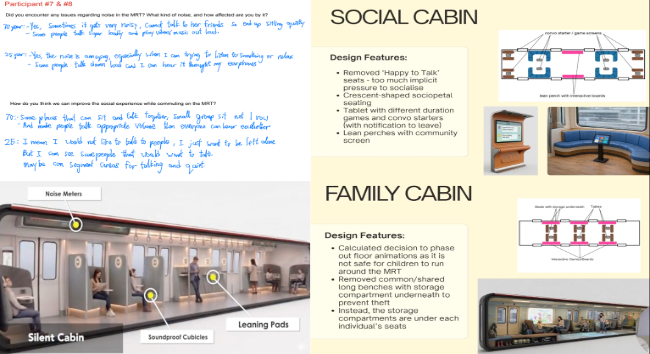
Students' participatory user research informing the prosocial transport solution in the "Introduction to Human-Centred Design" course.
SUTD Examples
At SUTD, students are also learning by making, sometimes with the aid of AI tools, but most definitely with their creative inspirations stirred by their instructors, lived experience, and user research. For example, in 02.005 “Introduction to Human-Centred Design,” Evelyn Chew (HASS) and Lyle Fearnley (HASS) invite students to redesign a mode of public transport to promote prosocial behavior. Students are encouraged to consider the multiple aspects of real-life challenges and cultural context, such as people’s reluctance to socialize with strangers or being on a crowded train. By using ethnographic methodologies (e.g., observations, semi-structured interviews, and surveys) as well as iterative participatory prototyping, students work to develop a creative solution—such as designating silent, social, and family cabins on a train—that respects both cultural realities and practical constraints of their users.