Recommendation #3: Teach students how to use AI ethically and effectively for your course
Global Context
Many generative AI tools excel at pattern recognition, but it always comes down to discernment practiced by humans to assess the accuracy and trustworthiness of computationally generated outputs. For those who had their educational training prior to the advent of AI, their disciplinary knowledge and domain expertise often enable them to assess the validity of AI-generated ideas and content. For students who are yet to be familiar with the domain knowledge, there is little ground on which they can evaluate AI responses.1 A professor at Columbia University’s Business School, for example, noticed that students had routinely resorted to ChatGPT summaries of business cases, in hopes of doing their homework more efficiently. As a result, these students overlooked the fact that it was their unique interpretative practices, grounded in careful reading and deliberations, that ultimately led to unique business solutions. To address this tendency among his students, he created a dialogical bot to challenge students’ lines of argument, as well as to help refine and expand their thinking.2
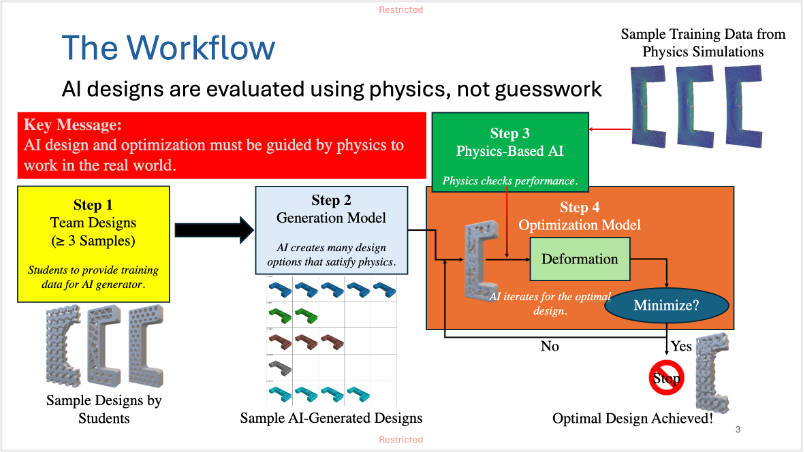
The "Physics-Based AI" approach taught in the "Structures & Materials" course.
SUTD Examples
Instructors at SUTD have also started to teach students how to cross-examine the validity of suggestions made by AI tools, so that students can benefit from the time-saving and generative mechanisms while recognizing their limitations. Hence, rather than replacing learning, AI is used to deepen it. For example, in 30.001 “Structures & Materials” taught by Chan Wai Lee (EPD), students test AI-generated structural designs through simulations and 3D-printed prototypes that were further subjected to tensile tests. This workflow allows students to observe how some AI-generated solutions may fail under real-world physical constraints, instilling in them both engineering judgment and an understanding of the capabilities and limits of contemporary AI technologies.
Similarly, in 50.003 “Elements of Software Construction” taught by Kenny Lu (ISTD) and Dileepa Fernando (ISTD), AI is integrated as a second opinion provider. Besides assessment, the course also encourages students to use the LLM/AI tools effectively to assess and cross-examine their teammates’ work. For example, asking the LLMs to generate a sequence diagram based on the teammates’ submitted pull requests might reveal how their descriptions of design and development guidelines could be incomprehensible or non-standard for others. Using the LLMs in this manner could help assist peer learning among students with AI as a tool and a teammate, as they offer assistance and guidance on how to better restructure the component descriptions.