Recommendation #2: Prioritise process-oriented assessment where appropriate
Global Context
As many in the world acknowledge that AI is a period-defining technology that is here to stay, institutes of higher learning are defining its optimal and critical adoption. For example, the University of Michigan has developed its bespoke GPT to ensure equitable access to emerging technology among its students.1 The general consensus suggests that a number of universities have resolved to equip students with critical AI literacy so that they have the power to decide how and when to use contemporary technologies, as opposed to letting the technologies dictate.2
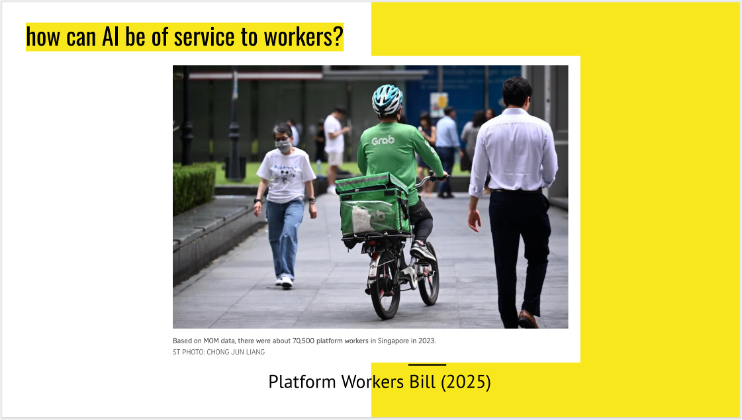
A lecture slide from the "Humanistic Design" course, inviting students to imagine the optimal role of AI in society.
SUTD Examples
As a design and engineering institution, students at SUTD are trained to design not merely to improve objects or systems, but also to enhance interpersonal relations in domains such as healthcare, finance, and the public sector, as well as our relations with other species and the environment as conscientious technologists. Growing public awareness of algorithmic biases, chatbots’ impact on young people’s mental health, extractive data collection and labor practices, and the environmental cost of AI means that engineers and designers are expected to be cognizant of the sociopolitical implications of their work and to demonstrate accountability in their practice.3 Courses like 02.535 “Humanistic Design: Ethics, Care, and Accountability in the Age of AI” taught by Setsuko Yokoyama (HASS), for example, feature established frameworks in software engineering like “Data Sheets for Data Sets,” drawing on intersectionality and other humanities and social science frameworks to promote more mindful and accountable engineering practices.4 Most importantly, students practice facilitating constructive dialogues among stakeholders with seeming conflicts of interest, such as musicians, streaming platform companies, developers of AI-generated music, and listeners. As weekly discussions and a mid-term presentation drive towards the final mock project proposal pitch, students can factor in weekly feedback on their work in progress to develop ultimately innovative business ideas.